Home Page
About Us
Evidence
Identification
Research
Big Cat News
Report a Sighting
Field Signs of Big Cats
Big Cat Links
Contact Us

Members Login
Register

View Sightings Map
View Sightings Map
Report Sighting

NFU

PAW


LATEST NEWS - 15th March 2006

EXCLUSIVE BBCS REPORT REVEALS STARTLING

NEW EVIDENCE FOR BIG CATS IN BRITAIN.

The latest report from the British Big Cats Society not only reveals startling new evidence for big cats in Britain, but also that the numbers roaming our countryside could be increasing. The report, covering research from April 04 to July 05, is to be published exclusively in the April issue of BBC Wildlife magazine on sale16 March 2006 (£3.25).
 
The BBCS report reveals that 2,123 sightings of big cats were reported between April 2004 and July 2005. The South West once again proved a hot-spot for sightings, with Devon, Cornwall and Somerset all featuring in the top ten big cat locations. Scotland came in third, seeing almost a 50% drop in sightings reported, and was replaced at the top by Devon. Wales was 4th on the list with 123 reported sightings and incidents. Almost 60% of all the sightings reported were of black cats, and 32% were of brown or sandy coloured ones, which the BBCS believes to be pumas.  Another 6% were lynx type cats.
 
New evidence published includes a skull found by a Devon farmer in July 2005 that has now been identified as that of a puma; three reported attacks on horses; over 35 incidents regarding sheep kills; several confirmed paw prints of which plaster casts were taken; and 17 reports of a big cat with cubs – an increasing trend, which suggests that the animals may be breeding. During the study over half a dozen hair samples, now awaiting analysis, were also collected.
 
The BBCS has also gathered evidence of at least 23 releases of big cats into the wild since the Dangerous Animals Act was passed in 1976, including a panther, pumas, lynxes and a host of exotics including caracals, ocelots and jungle cats. Many of the original owners are now owning up to their past misdeeds.

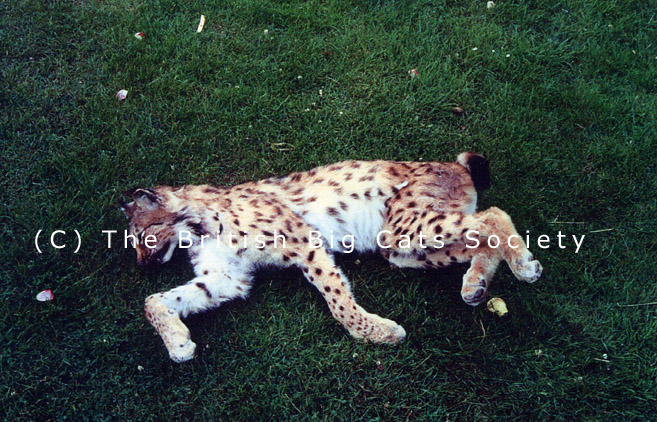
      The Skull found by a Devon farmer in July 2005 that has now been identified as that of a puma

Sophie Stafford, Editor of BBC Wildlife magazine, comments: “The thought of big cats roaming the British countryside has captured many people’s imagination, but until now proving their existence has been impossible.  With fresh new evidence and sightings on the increase, the British Big Cats Society is now tantalisingly close to being able to provide conclusive proof of their presence.”

Keen to expose evidence that is not genuine, the BBCS also reveals in BBC Wildlife magazine that it has in the last year uncovered several ‘hoaxes’, including a photo of a supposed black panther printed by two national tabloids in April 2005. It turns out, the big cat is in fact a full size black cuddly toy panther.
 
Danny Bamping, spokesman for the BBCS says: “This is a good example of how easy it is to produce a hoax. This year we have been able to study evidence in greater detail and estimate that just under a third of all reported sightings are not big cats - either people have been mistaken or their reports are too vague. There are also those people who insist on reporting the likes of The Pink Panther, Garfield, Top Cat and Simba.”
 
The BBCS is hoping for national support from the Government, in particular the police and Defra, and can confirm that some regional police forces are already taking a keen interest. Gloucester Constabulary’s Wildlife and Environmental Crime Officer Mark Robson has been collating sightings since 1999, and has developed a contingency plan setting out what police officers should do when they receive a big cat report. Robson is also working with the BBCS to build a nationwide database of big cat reports to help understand the animals’ movements.

Defra still maintains a cautious approach to the subject. A Defra spokesperson recently told BBC Wildlife magazine: “Based on the evidence, Defra does not believe that there are big cats living in the wild in England. We do not have a remit for animals in the wild in Wales, Scotland or Northern Ireland.”

The BBCS intends to continue its research and obtain hard evidence by using camera traps that are triggered by animal movement – a technique that has been used to film rare Sumatran tigers in the wild, helping them to ‘Prove and Protect’ the big cats roaming Britain, determining species and possibly numbers.
 
If hard evidence of big cats roaming Britain is found, it could also have a great impact on conservation issues.  Andrew Kitchener of the IUCN Cat Specialist Group told BBC Wildlife magazine: “Fossil evidence indicates that the lynx survived in Britain until 1,500 years ago, its extinction due to human activity rather than environmental changes. Now there is growing interest in the idea of restoring the lynx to the UK.  If it could be demonstrated that big cats were living in the British countryside with little or no impact on people or their livelihoods, this would strengthen the case for the lynx’s return.”

Other News - September 1 st 2005

PHOTO OF BIG CAT PROVES TO BE A FAKE!

Over the years several ‘hoaxes’ have been exposed by the British Big Cats Society; this now includes a photo of a supposed Black Panther printed by 2 national tabloids back in April. The digital photo taken in South Wales was investigated in detail by the BBCS and has now been exposed by them as a picture of a full size black cuddly toy  - Panther.

Danny Bamping (spokesman for the BBCS) said today:

“The South Wales photo was a pretty good example of how easily it is to produce a hoax, and at the time the editors of the papers must have thought they were onto a winner. It doesn’t help when this kind of thing occurs especially in an area where there are genuine sightings occurring.”

Norman Evans from Cwmbran took this photo on his digital camera - and still to this day maintains it is actually of a Black Leopard. After indepth investigation we believe 100% that it is in fact a Large cuddly toy!

Below is an extract from the letter we sent to Norman after we investigated this photo:

Dear Norman

After fully evaluating the photograph, considering the circumstances in which it was taken – and visiting the place myself & talking to you in detail; I have made the following conclusions from the evidence surrounding your ‘Big Cat’ image taken in the woods in Cwmbran, South Wales.

1 – The Digital memory card you gave me has 3 images on –

These all have ‘code numbers’ which identify each image:

The numbers were;

P1010001 & P1010002 & P1010007                  

0001 & 0002 are the first 2 images – and they were both of Hailey (your partner) on the edge of the woods – (which I can confirm are the same woods you took me too)

P1010007   - The 3rd Image is your ‘Big Cat’ Image.

As you can see by the numbers there are 4 images therefore missing – I accept that they may have been deleted ‘as you go’ whilst photographing – which is the only way this could have happened. However the fact that you never mentioned you had done this – and the fact there are only those 3 images on the card – does make it somewhat ‘suspicious’.

2 – The FACT you were able to get so close to the animal is rather ‘confusing’ to say the least. No ‘Wild large feline’ – would ever allow it and even in places such as Africa – it’s highly, highly unlikely.

3 – The FACT you only ever took 1 photograph of your ‘Big Cat’ – does not help strengthen the validity of your image – if anything it weakens it.

4 – The FACT that the ‘big cat’ in your image – has a broken tail in 2 places – which bends at 2 different angles. Cat’s tails are simply not able to do this – if they do they are damaged and the cat would be in a lot of pain. This can be seen clearly in the ‘closer’ image below.

5 - From looking in detail at the digital image taken straight from your card and putting it through several professional photo packages we have been able to verify the following;

A) Towards the front of the ‘big cat’ – you can now see an eye and also a tongue and a clearer outline of its face. The ‘big cat’ looks – completely ‘dead & lifeless’ and the head shape & neck are far too thick for the type of feline this ‘represents’.

B) On the back of the animal the sun is reflecting on it – this does not look like fur – more like ‘velvet or brushed cotton’.

C) Looking at the ‘paws’ of the animal, they do not look real.

D) There is no blood anywhere to be seen.

E) The general ‘thickness’ of the animal is too big.

F) It is not sat right and looks to be lying in a very uncomfortable & awkward position.

6 – Having been to the location myself I can confirm:

a) It is certainly the place where the image was taken.

b) There were remains of a dead animal possibly pigeon.

c) There was no other evidence of ANY cat at the scene – no paw prints – no tree scratching – no smell - in fact not much at all.

d) There was evidence of the woods at that location being ‘used’ by humans regularly in some way – walking dogs, camp fires, shelters.

After considering all of the above, I firmly believe that the photograph (P1010007) is actually of a large, stuffed ‘cuddly toy’ – full size – Black Panther. These are easily available from various sources.

I do however firmly believe that in your immediate & surrounding areas – there are big cats – most of which that are sighted are either Large Black Panther ‘type’ Cats (possibly melanistic Leopards) – or Brown / Sandy coloured cats, (which we believe to be Pumas). On occasion not too far away we have also had a few definite sightings reported of Lynx. So there are big cats around and they do move around the ‘welsh boarders’ often, it’s a very active area for big cats.  

Unfortunately your photograph is not one of them.

Yours faithfully,

Danny Bamping

Founder & Media spokesman

The British Big Cats Society

http://www.britishbigcats.org

Other recent news...23 rd August 2005

About the BBCS
More about the British Big Cats Society.
Evidence
Physical, scientific, photographic and video of big cats.
Report a Sighting
Report your big cat sighting to an area member.

New BBCS Website Launched
Encounter In London
Live Web Cam Evidence
Calls For Government Study
Appeals for More Evidence
BBCS to work with NFU members
Over 1,000 Big Cats Seen

Data Analysis
News and Events
Exclusive Photographs